A game of the MarchesPlays in your browserNo charge

The Shattered
Marches

Forty years ago nine miners went into the hill above Deansbury. The reeve went in after them, and the Workings were sealed behind him. They buried an empty coffin.

Play free in your browser

Nothing to download or sign up for. On a phone, add it to your home screen and it plays with no signal at all.

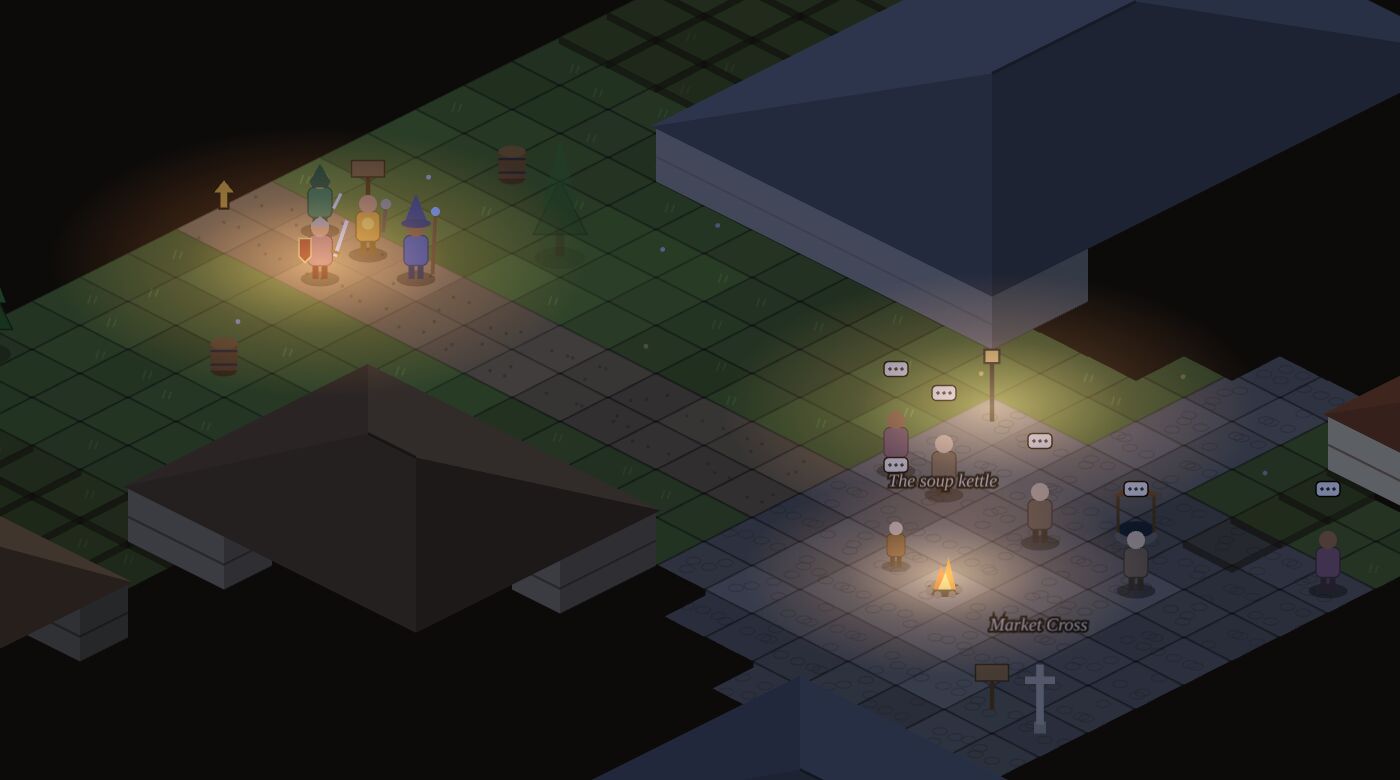
Deansbury at half past eight at night, drawn in isometric: the company of four stands under a lamp by the church; across the square a queue waits by a soup kettle lit by a small fire, near the market cross.
Plate I. Deansbury at half past eight, in a hungry year. The kettle on the green is the church’s, and the people queuing at it are not all from here.

I.

A market town with a hole in it

Deansbury sits on the Dean’s Water in the shadow of High Tor. It was an iron town once. Then the Tor Workings were sealed, and it has been a poorer town ever since, and a quieter one, and the quiet has gone on long enough that most people have stopped asking why.

You come in along the west road with the dust of it on you. Somebody is taking Wat Harrow’s sheep off the slopes, a few a week. The village says wolves. Wat says wolves don’t carry knives. The Reeve has nailed another notice to the market cross about keeping away from the old Workings, as if anybody would be fool enough to go up there.

Elsa Hale keeps the Tor & Tankard and hears everything, and tells you some of it. Brother Cuthbert tends a grave in St Aldhelm’s churchyard with nobody in it. Ask either of them about the Workings and you will get the story every child in Deansbury knows, and a look that says there is more to it.

There is.
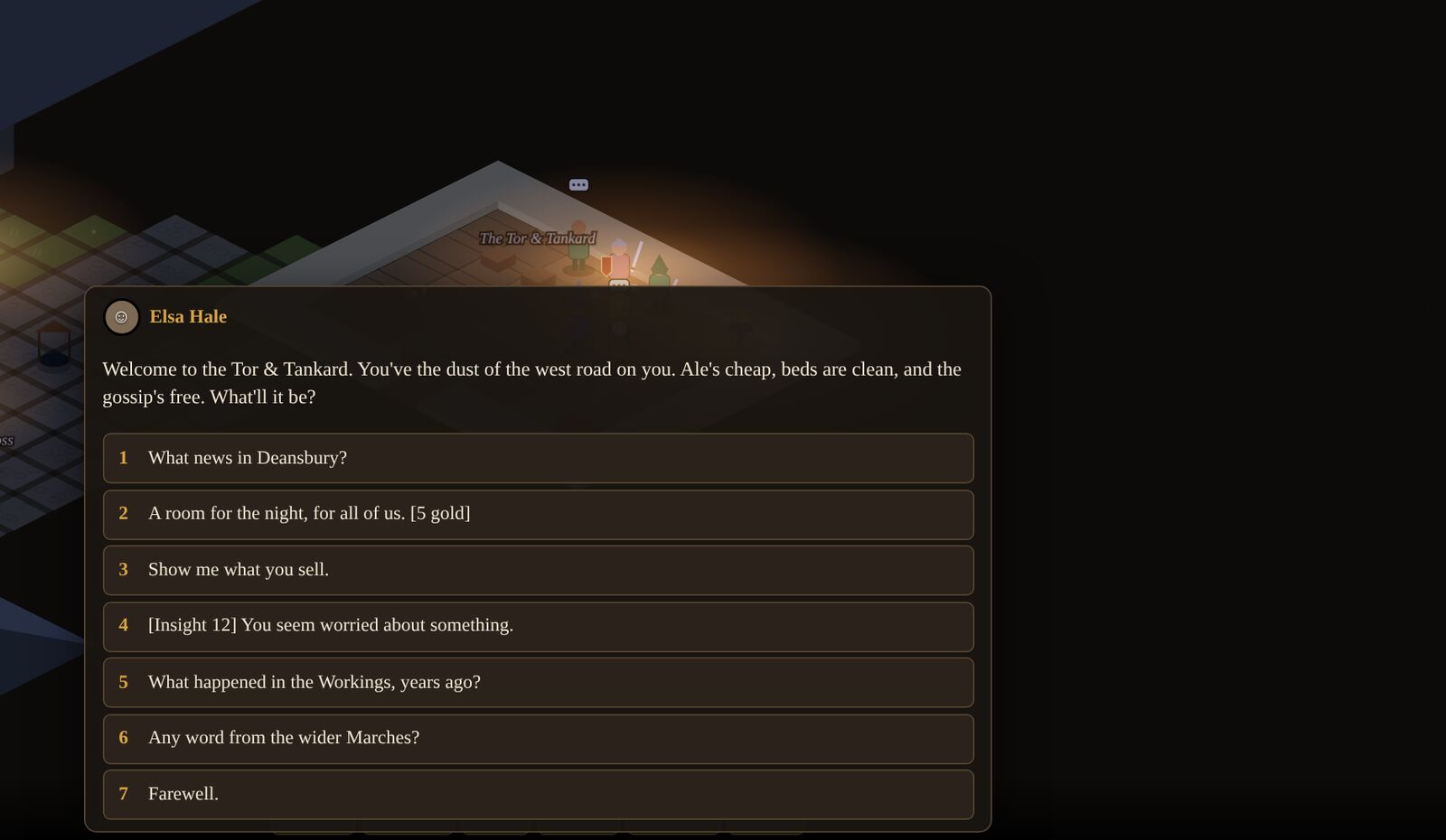
A conversation with Elsa Hale at the Tor & Tankard at night. She welcomes the company; the choices include asking what news there is, taking rooms, and a check to notice that she seems worried about something.
Plate II. Elsa Hale. The fourth choice is a test of Insight: she is worried about something, and she will only say what if you notice.

II.

What the hill keeps

The history of the Marches is written down in a great many places, most of them inconvenient: in charters, ledgers, the backs of altars, the insides of tomb lids. Nobody hands it to you. You find it in pieces, and the pieces disagree, and some of them were written by people who were lying.

These are a few of the pieces. There are more.

  1. No gallery shall be driven below the third level, for the hill is not empty.

    A clause of the founding charter of the Iron Guild, which the Guild never reads aloud.

  2. The oldest carving on the altar shows the saint with a hand on a door, not a book.

    St Aldhelm’s, Deansbury. The church was built where it was for a reason.

  3. Aldren Voss took a lantern, a blessed sword and his seal-ring below. He left the lantern in his own niche on the way. He meant to come back for it.

    The reeves’ niches, beneath the church.

  4. Aldren went down by two ways, and only one needs watching.

    A ledger kept by the Dean. Watching for what? And for whom?

  5. The Circle holds that the Wardens are jailers and the Hollow is a kingdom. Open the doors and every buried king rises to his throne.

    A chronicle in a priory hand, from a house that has since fallen silent.

  6. The kings of before the Marches made pacts with what lay under the hills, and were buried sitting up, facing their doors.

    Ogham cut into a recumbent stone, inside a ring of standing stones.

  7. I gave the Hollow my name, and it gave me a hundred years. It will want the name back.

    Scratched inside a tomb lid.

  8. You dream you are standing in the Deep Hall and the door is open a finger’s width, and something on the other side is counting.

    A dream. You will have others.

A map of Deansbury and its neighbourhood Deansbury sits on the Dean's Water, with High Tor and the sealed Tor Workings to the east, Harrow Wood below the slopes, and the west road to Ashford. The edges of the map are left in pencil: they are drawn fresh for every campaign. Here the mapis drawn anew …and here,for every campaign The Dean's Water DEANSBURY market town · church of St Aldhelm ASHFORD High Tor the Tor Workings (sealed) Harrow Farm Harrow Wood ? N a morning's walk
Plate III. Deansbury and its neighbourhood. The inked part is the same in every campaign. The pencilled part is not: twenty regions, three centuries of history, and whatever that history left in the barrows are generated fresh from your seed, before you arrive.

III.

How it plays

It is a role-playing game in the old manner: a company of up to four, turn-based fights, a great deal of talking to people, and a world that is indifferent to whether you are the hero of it. You tap once to look and again to act. Nothing happens in a fight until you choose to act, and the game tells you your chances before you do.

Every problem has more than one way through

Harrow’s sheep can be settled with swords, with a quiet word, with a report to the Reeve, or by leaving it alone and seeing what happens to the farm. The Reeveship can be decided by a dead man’s ring, a town meeting, a notice nobody has read in years, or a knife under the bridge. Doing nothing is always one of the ways, and it is always a choice with consequences.

The world does not wait for you

Outlaws take the roads, the dead walk near old battlefields, cults paint circles on doors, and all of it gets worse by the day whether you deal with it or not. News walks the roads at the pace of a person, a village a day. Prices follow what is scarce. A pedlar makes his rounds, and sometimes he is robbed on the way.

Fights are about the ground

Oil burns, water freezes, smoke blinds, and a shove off a ledge is as good as a sword. Wolves hunt in packs and break when the pack breaks. Trolls mend unless you burn them.

Company is a choice too

People you meet on the road will join you, and they have opinions. They care about mercy or the law, faith or coin, their own kin, or simply finding out. They will tell you what they think of what you did, and if you keep doing it, they will leave.

It ends with a chronicle

When the story of your campaign closes, the game writes it down: who became reeve, which towns prospered and which burned, what was sealed and what was let out, and what the Marches said about the company that came in along the west road.

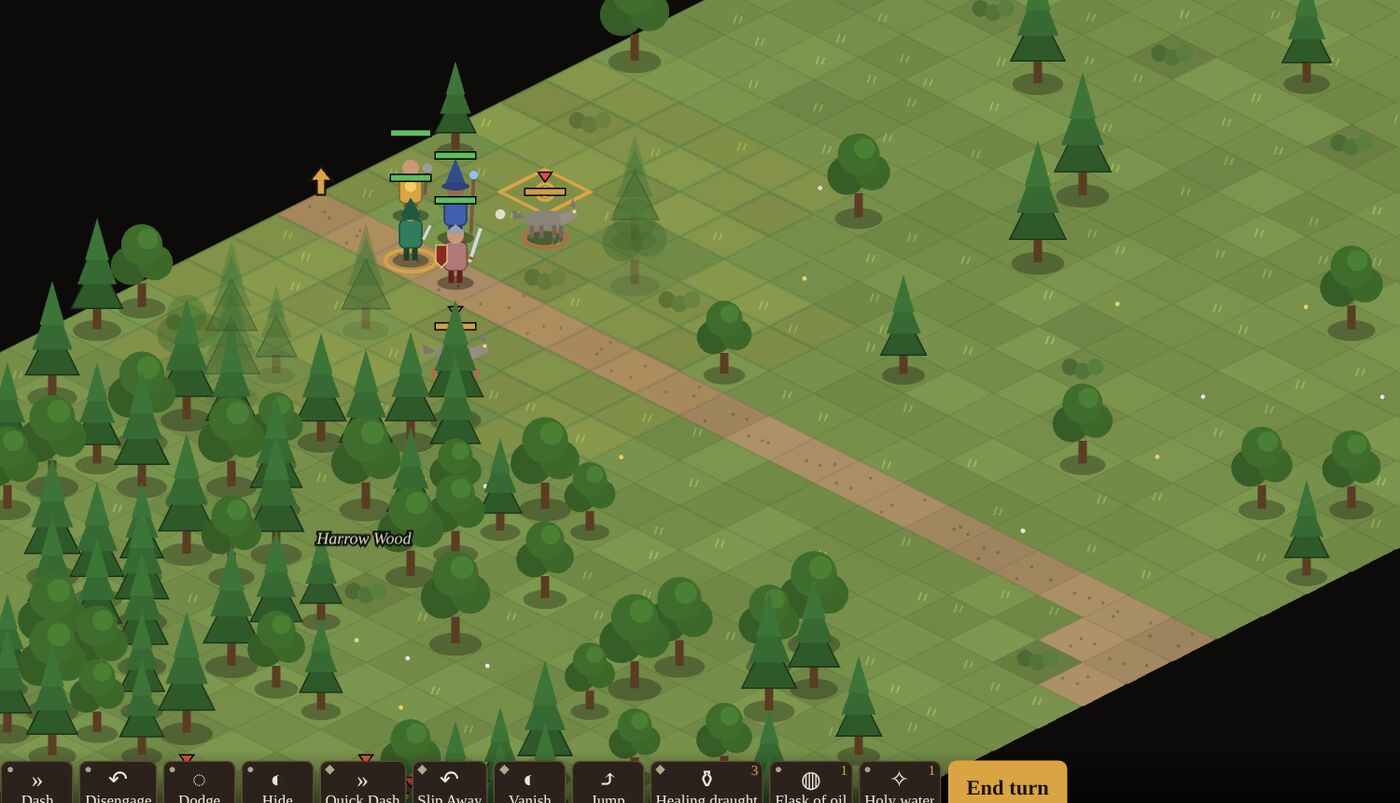
A fight on the Tor Slopes by morning: the company on a woodland track, two wolves closing in, one of them marked as the current target.
Plate IV. Two wolves on the Tor Slopes, by Harrow Wood. The rogue is up first.
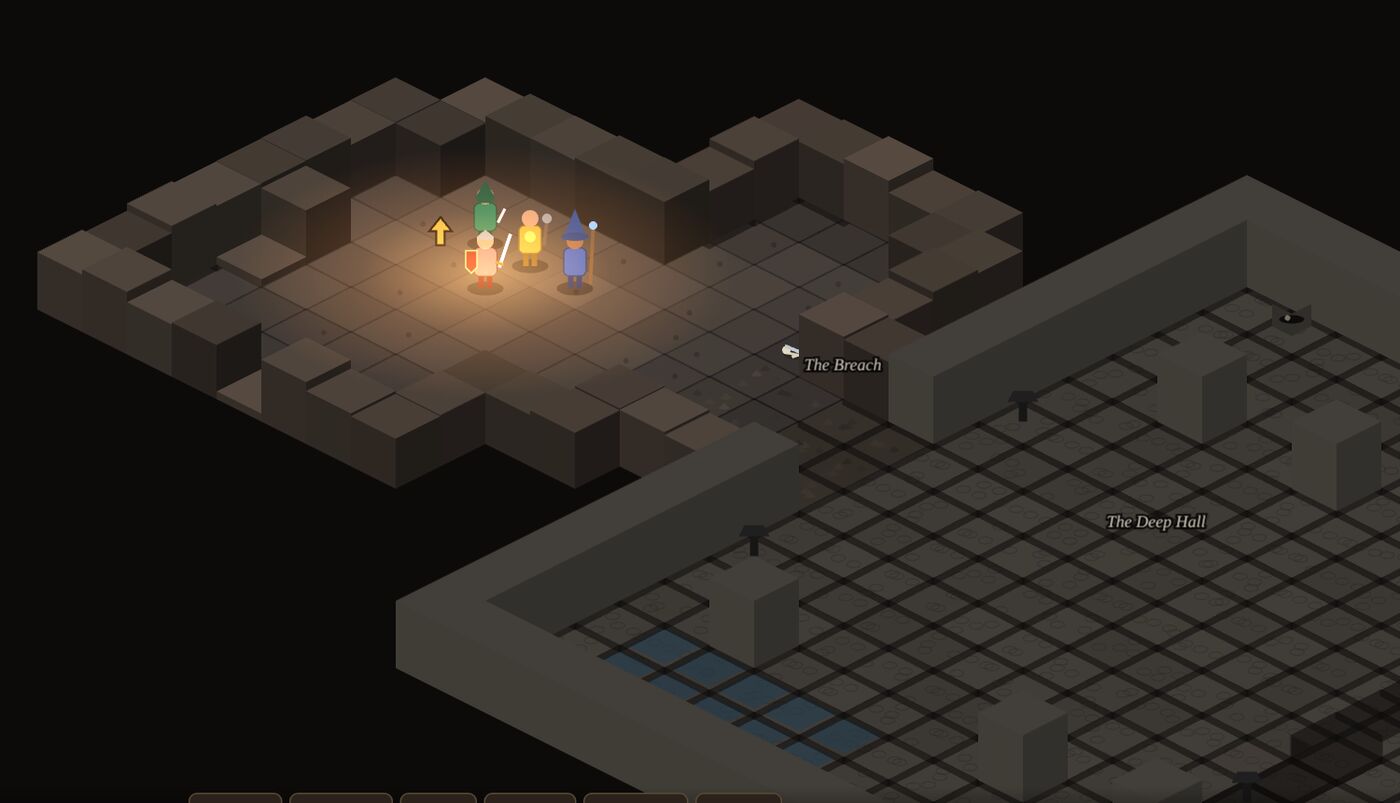
The company in the Deep Hall under the Tor, standing in the one pool of light at the breach; the great hall beyond is stone, pillars and dark water.
Plate V. The Deep Hall. You bring your own light, and it does not go far.

IV.

The small print

Where it runs
In any modern browser, on a phone, a tablet or a computer. Touch, mouse or keyboard.
Without a signal
Add it to your home screen (Share, then Add to Home Screen on an iPhone) and after the first visit it plays in Airplane Mode.
What it costs
Nothing. There are no accounts, no adverts, no analytics and no cookies.
Your saves
Stay on your device, and can be exported to a file and taken to another one.
Your company
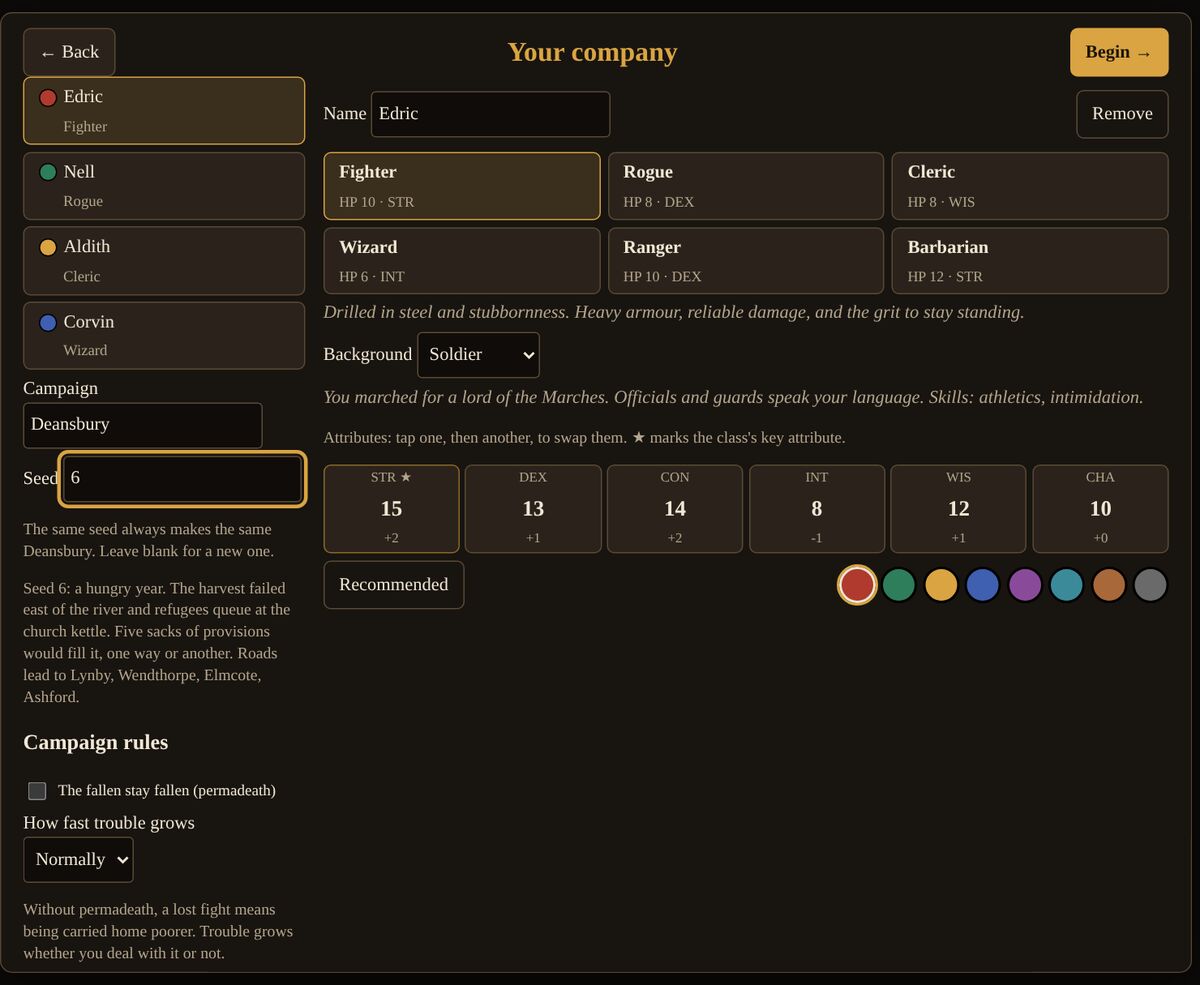
Fighter, rogue, cleric, wizard, ranger or barbarian, with a background each. Or take the ready-made four and go.
If you like it hard
Turn on permadeath, and choose how fast trouble grows.
The company screen: four adventurers, the six classes, attributes, and the seed box, where seed 6 is shown to be a hungry year.
Plate VI. Making a company. Type a seed and it tells you which Deansbury you will find.